
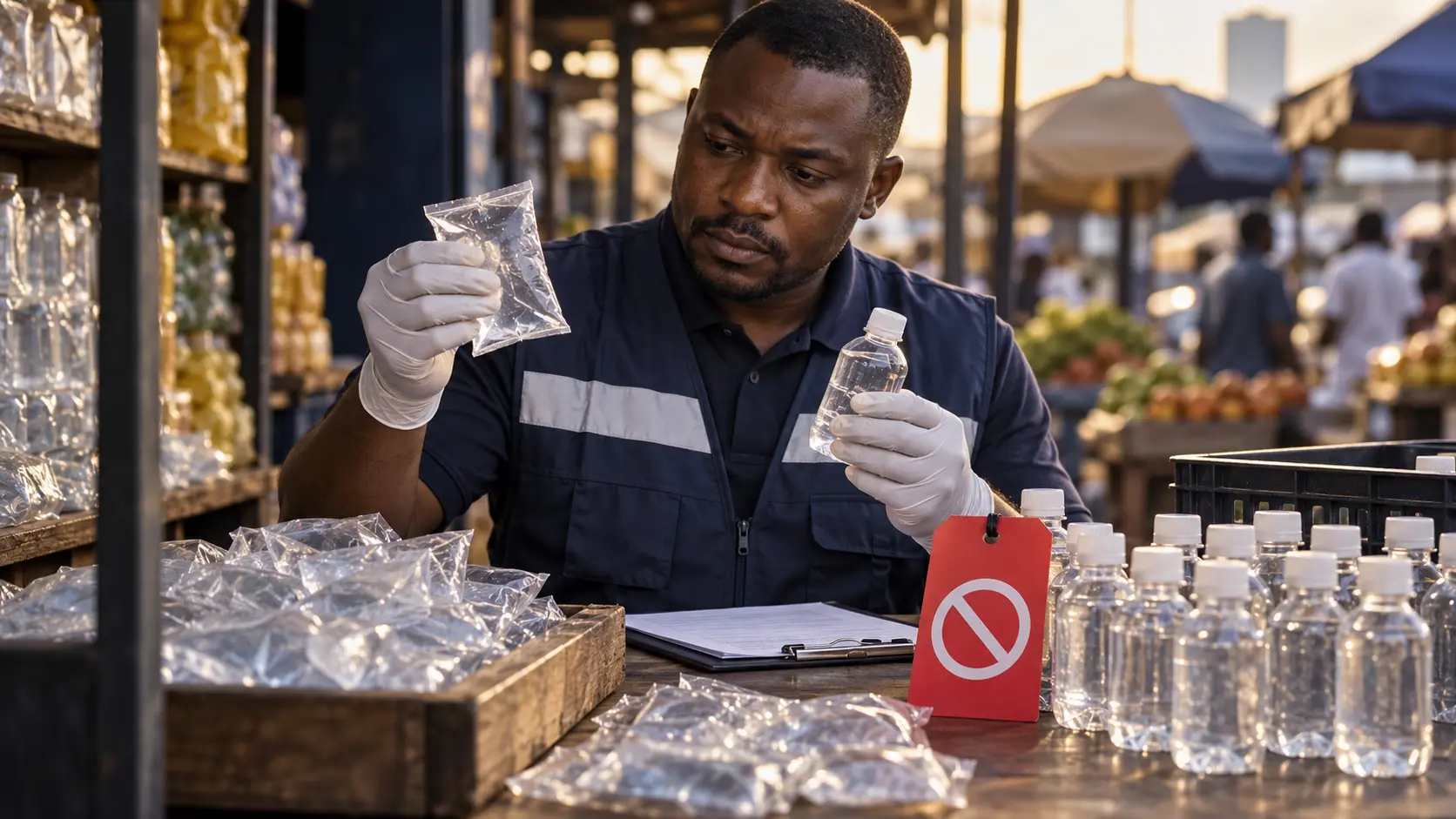
Nigeria's long-running argument over alcohol sold in sachets and very small bottles has moved from phase-out promises to nationwide enforcement. In August 2026, NAFDAC ordered affected manufacturers to recall prohibited products or face sanctions. The useful public question is no longer whether the policy exists. It is what the policy actually says.
Start with the shortest accurate explanation
The restriction applies to alcoholic beverages packaged in sachets and in PET or plastic bottles smaller than 200 millilitres. NAFDAC has described the prohibition as covering production, importation, distribution, sale and use of those formats.
It does not mean that Nigeria has prohibited all alcohol. It does not mean every drink below 200ml, regardless of what it contains, is banned. And it does not mean every approved alcoholic beverage in a larger container has become illegal. The product and the package size both matter.
That distinction is important for consumers, retailers and businesses. A regulation should be understood through its exact scope—not enlarged by social-media shorthand and not reduced by industry reassurance.
- Alcoholic beverages in sachets are within the prohibition.
- Alcoholic beverages in PET or plastic bottles below 200ml are within the prohibition described by NAFDAC.
- The policy is not a nationwide prohibition of every alcoholic beverage.
- Businesses should verify product-specific compliance and current directives directly with NAFDAC.
This was not announced overnight
The timeline began years before the 2026 enforcement photographs. NAFDAC says regulators and industry groups signed a memorandum of understanding in December 2018 to phase out alcohol in sachets and small-volume containers. Manufacturers received a five-year period to change production lines and move to larger formats.
The original transition period ran to January 2024. Enforcement efforts then met industry resistance and intervention from the National Assembly. The Federal Government extended the moratorium to 31 December 2025, giving the sector additional time to adjust and dispose of stock.
According to NAFDAC's account, the ban took effect on 1 January 2026. The agency began first-tier enforcement in January, carried out a second nationwide market and distribution-centre operation in July, and in August ordered manufacturers to undertake recalls of remaining prohibited products.
The sequence matters because it answers the claim that businesses were given no warning. It also explains why consumers may still have seen sachets after the effective date: a rule can be in force while prohibited stock, disputed production and enforcement activity continue to coexist.
Why package size became a public-health issue
Small alcohol packs are cheap, portable, easy to conceal and easy to consume quickly. Those qualities make them commercially effective. They can also make alcohol easier for children and other vulnerable people to obtain.
NAFDAC says the policy is intended to reduce underage drinking, harmful use and access to high-strength alcohol in formats that are difficult to control. In its August briefing, the agency cited research indicating that substantial proportions of underage purchasers obtained alcohol in sachets and small PET bottles.
The wider public-health argument is consistent with World Health Organization guidance: alcohol harm is shaped not only by individual choice but by availability, affordability and marketing. WHO's global alcohol action plan asks governments to use evidence-based policies that change the environment in which alcohol is sold and consumed.
A container rule is therefore not built on the idea that plastic itself creates intoxication. It is an attempt to change the price, convenience, concealability and retail reach of particular products.
What manufacturers and retailers are being told to do
NAFDAC's August 2026 position went beyond asking factories to stop producing new stock. The agency said affected manufacturers must recall prohibited products from distributors, warehouses and other parts of the supply chain and submit compliance reports.
It also said recalled products would be verified and destroyed under regulatory supervision. For facilities sealed over non-compliant production, reopening would depend on evidence that relevant production lines had been dismantled, disabled or reconfigured, alongside inspection and other compliance requirements.
The agency listed possible consequences for defaulting companies including continued closure, placement on a regulatory watchlist, suspension or revocation of product registrations and prosecution where applicable.
Retailers and consumers are not well served by guessing. A product that remains physically available is not automatically compliant. Current registration status, packaging and official directives should be checked with the regulator.
The jobs argument is real—but it is not the only question
Distillers and other industry stakeholders have warned that a ban could damage businesses and employment. That concern should be reported accurately. Production lines, distributors and retailers are connected to people's incomes.
But an economic impact does not by itself decide whether a health regulation is justified. Governments routinely have to weigh employment, transition costs, tax revenue and commercial freedom against harm, enforcement feasibility and the protection of minors.
A serious assessment should ask whether affected businesses received a credible transition period; whether the rule is applied consistently; whether larger replacement packs simply create new problems; whether informal and unregistered alcohol expands; and whether health outcomes are actually measured after implementation.
The policy should ultimately be judged by evidence: changes in underage access, harmful drinking, injuries and illicit production—not by the volume of applause or anger surrounding it.
What the ban cannot do on its own
Removing a package format does not remove alcohol dependence, harmful drinking or the social conditions that can drive both. It does not replace enforcement of age restrictions, drink-driving laws, advertising standards or rules against unregistered products.
It also does not provide treatment. People living with alcohol-use disorders need confidential, affordable services—not only smaller opportunities to purchase one type of product.
There is a predictable risk that demand moves elsewhere: to larger bottles, informal products or unregulated sellers. That makes surveillance and public communication essential. A successful policy needs enforcement strong enough to prevent an illicit substitute market and health services capable of helping people already experiencing harm.
The practical answer for the public
If the product is an alcoholic drink in a sachet, NAFDAC says it falls within the prohibition. If it is an alcoholic drink in a PET or plastic bottle below 200ml, the agency says it falls within the prohibition. Do not assume that continued availability means official approval.
For businesses, social-media summaries are not compliance advice. Confirm current product registration and enforcement requirements with NAFDAC. For consumers, avoid products with doubtful registration, broken seals or unclear labelling and report suspected prohibited production or sale through the agency's official channels.
The policy may continue to face commercial and political debate. But as of 6 September 2026, NAFDAC is publicly describing the ban as effective and is pursuing recalls and enforcement. That is the current position a careful explanation must reflect.
Sources & further reading
CHA Health uses named, traceable sources. Links open the original institutional material.
- NAFDAC NigeriaNAFDAC commences nationwide mop-up of banned sachet alcohol and sub-200ml PET bottles
- PUNCH HealthwiseSachet alcohol: recall products or risk closure, NAFDAC warns manufacturers
- The Guardian NigeriaMinistry affirms NAFDAC's right to enforce sachet alcohol ban
- World Health OrganizationAlcohol: key facts and WHO response


Read thoughtfully.
Respond constructively.
Loading discussion…