
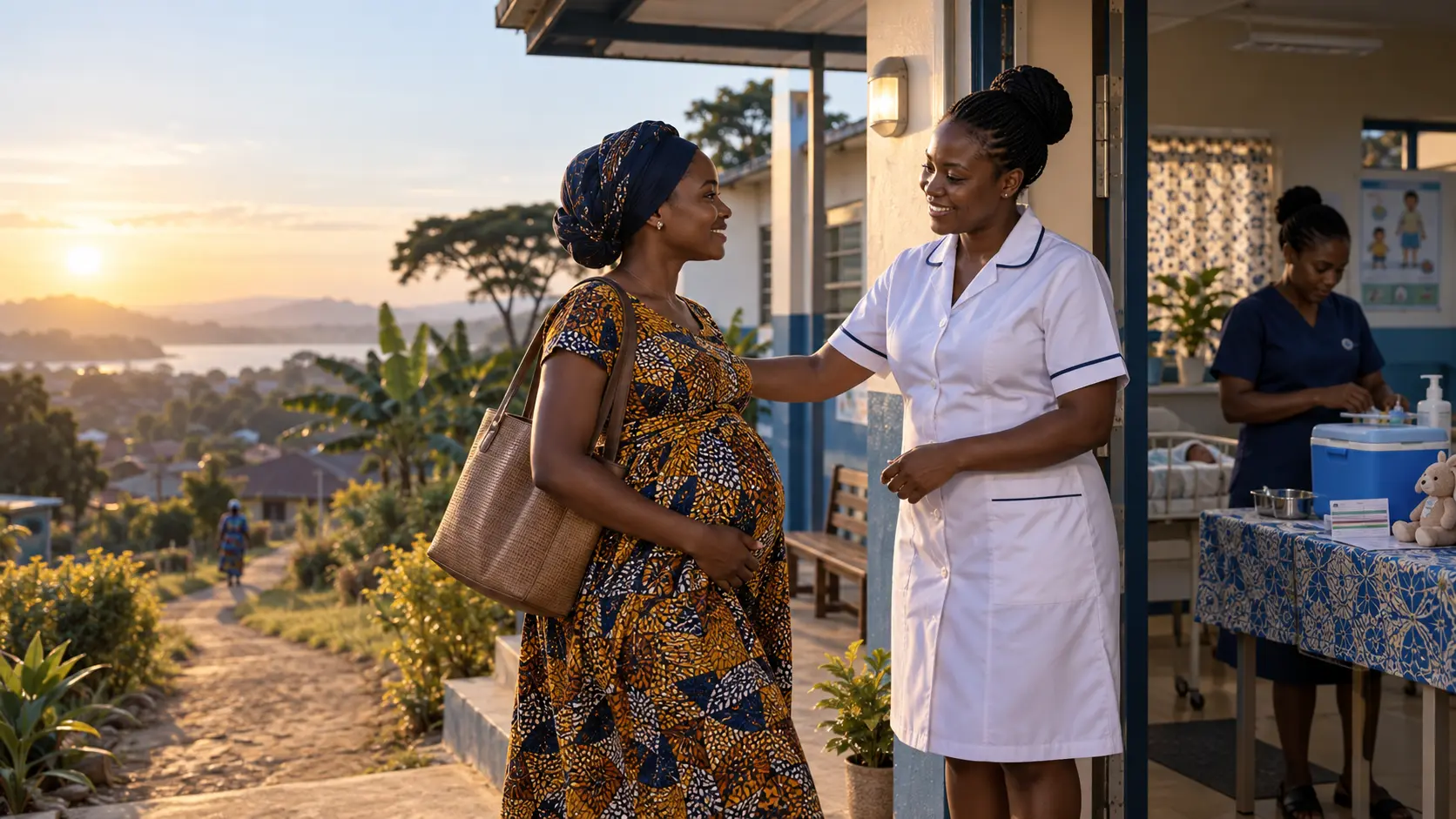
On 9 September in Arusha, African health leaders launched a continental roadmap built around three unusually direct promises: zero home deliveries, zero preventable maternal and newborn deaths, and zero unvaccinated children. The language is powerful because nobody needs a policy degree to understand it. The danger is that a memorable slogan can make an extraordinarily difficult systems problem sound simple.
Three zeros simple enough to remember
The African Union Champion's Roadmap on Reproductive, Maternal, Newborn, Child and Adolescent Health 2026–2030 was launched in Tanzania under President Samia Suluhu Hassan's continental advocacy role. Africa CDC presented the Three Zeros as the organising ambition: no home delivery, no preventable maternal or newborn death and no child left entirely outside routine vaccination.
There is value in making a public-health promise legible. Maternal and child-health strategies often arrive wrapped in indicators, frameworks and abbreviations. Three zeros can be repeated in a clinic, a parliament, a radio interview and a community meeting without translation into bureaucratic language.
But each zero conceals a chain of difficult questions. Can a woman reach care at night? Is the facility staffed? Is blood available? Will she be treated with respect? Can the clinic keep vaccines cold? Does it know which child missed a dose? Can governments see the same gaps at district level that appear in a continental total?
A zero is not a campaign message. It is the point at which every weak link becomes visible.
Zero home delivery cannot become zero empathy
The phrase zero home delivery is the most immediately provocative part of the roadmap. A safe birth with skilled care is a sensible objective. Complications such as haemorrhage, sepsis and obstructed labour can become fatal quickly, and a trained professional working within a prepared referral system can change the outcome.
Yet a woman who gives birth at home is not automatically rejecting medicine. She may be hours from the nearest facility. Transport may be unavailable after dark. The family may fear the bill. A previous facility birth may have involved humiliation or neglect. Labour may progress too quickly. Conflict, flooding or insecurity may make travel dangerous. In some places, the clinic is physically present but cannot offer the emergency care its signboard appears to promise.
UNICEF estimates that only 64 per cent of births in sub-Saharan Africa occurred in health facilities in 2023. The average hides a sharp inequality: facility delivery was estimated at 83 per cent among urban women and 56 per cent among rural women. Among the richest women it reached 90 per cent; among the poorest, 43 per cent.
Those gaps do not describe a continent divided between women who care about their babies and women who do not. They describe unequal access. If zero home delivery becomes a target used to blame mothers, punish traditional attendants or chase a percentage without improving care, the policy will misunderstand the problem it is trying to solve.
A roof does not make a birth safe
Moving childbirth into a facility is not the same thing as guaranteeing quality. UNICEF's latest delivery-care analysis estimates that 74 per cent of births in sub-Saharan Africa were attended by a doctor, nurse or midwife in 2023. That is progress, but it still leaves millions of births without skilled attendance—and the presence of a trained professional alone does not reveal whether medicines, water, electricity, blood, theatre capacity or referral transport are available.
Even the standard indicator has limits. UNICEF notes that skilled attendance cannot fully capture whether the attendant has the supplies and equipment needed when a complication occurs. A midwife can recognise severe bleeding and still be trapped inside a facility without blood. A clinician can diagnose eclampsia and still face a medicine stock-out. A referral can be clinically correct and operationally impossible.
Quality also includes how women are treated. WHO's intrapartum-care guidance places dignity, communication, privacy, informed choice and a positive childbirth experience alongside clinical safety. That is not decorative compassion. A woman who expects abuse or disrespect may delay returning to the same system during her next pregnancy.
The credible goal is therefore not merely to move births indoors. It is to make safe, respectful care close enough and reliable enough that arriving at the facility is the rational choice.
Zero preventable deaths means owning every broken handoff
The maternal mortality numbers remain devastating. WHO and its UN partners estimate that about 260,000 women died from causes related to pregnancy and childbirth in 2023. Sub-Saharan Africa accounted for roughly 182,000 of those deaths—about 70 per cent of the global total. Most maternal deaths are preventable or treatable with knowledge medicine already possesses.
The major causes are familiar: severe bleeding, infection, hypertensive disorders such as pre-eclampsia and eclampsia, complications of delivery and unsafe abortion. The clinical response is also familiar. What varies is whether the right action can happen before the patient runs out of time.
Newborn survival is tied to the same chain. UNICEF estimates that 2. 3 million babies died during the first 28 days of life in 2024. Sub-Saharan Africa had the world's highest regional neonatal mortality rate, at an estimated 26. 6 deaths per 1,000 live births. Prematurity, events during birth, pneumonia and sepsis accounted for most newborn deaths.
Zero preventable deaths cannot be delivered by a maternity ward acting alone. It requires transport that arrives, triage that recognises danger, laboratories that return results, blood that is usable, theatres that function, newborn resuscitation, postnatal follow-up and records capable of showing where the chain broke.
Zero unvaccinated children is a map of exclusion
The third promise concerns zero-dose children: children who have not received even the first routine dose used as a marker of access to immunisation services. The label can sound technical. In reality, zero-dose status often reveals something larger than vaccination. It can point to a family living beyond the routine reach of the health system.
UNICEF and WHO estimated that 13. 5 million children worldwide received no routine vaccine dose in 2025. More than half were concentrated in nine countries, including Nigeria, the Democratic Republic of the Congo, Ethiopia and Angola. West and Central Africa recorded the lowest regional coverage for the third dose of the diphtheria-tetanus-pertussis vaccine, at 71 per cent.
The reasons are rarely solved by telling parents to care more. Conflict interrupts outreach. A stock-out turns a completed journey into a wasted one. A caregiver who loses a day's income to visit a clinic may not return after being told to come back. Poor records make missed children hard to find. Misinformation travels quickly where trusted explanation arrives slowly.
A zero-dose child is therefore an indicator of disconnection. Finding that child may also uncover malnutrition, an unregistered birth, missed antenatal care or a household facing several barriers at once.
The three zeros are really one promise
Maternal care, newborn survival and childhood immunisation are often managed as separate programmes. Families do not experience them separately. The woman who reaches a trusted antenatal clinic is more likely to know where to deliver. The facility that manages her birth safely has an early opportunity to protect the newborn. The clinic that records the child accurately has a better chance of bringing the family back for vaccination.
The reverse is also true. A mother who is treated badly may avoid postnatal care. A baby born outside a connected facility may be invisible to follow-up. A family that travels a long distance for one appointment may struggle to repeat the journey for several vaccine visits.
This is why the roadmap's three promises should not become three competing vertical campaigns. They are three views of the same relationship between a household and a functioning primary-health system.
The most valuable unit of progress may not be a poster, a launch event or even a national average. It may be continuity: one woman known by the system through pregnancy, safe delivery, the newborn period and the child's immunisation schedule.
What serious accountability would look like
The year 2030 is close enough that broad continental commitments must quickly become specific national and district plans. A country cannot manage what it only announces. Governments need to know where home deliveries are concentrated, which facilities cannot manage emergencies, where referral times are longest and which communities account for missed vaccinations.
Targets should be published with denominators, budgets and timelines. Maternal and newborn deaths should be reviewed to identify avoidable delay without turning review into punishment. Facilities should report stock-outs and referral failures. Data should be disaggregated by location, wealth and vulnerability so progress among well-served urban families does not conceal exclusion elsewhere.
The workforce matters just as much as the metrics. A promise of skilled care is meaningless without enough midwives, nurses, doctors, laboratory professionals, ambulance teams and community health workers—paid reliably and distributed where the gaps are greatest.
And women must be included as judges of quality. A system cannot honestly call itself accessible if the people using it describe fear, mistreatment or cost as reasons they hesitate to return.
- Fund round-the-clock referral and emergency obstetric and newborn care, not only daytime clinic attendance.
- Publish district-level progress and equity gaps, not national percentages alone.
- Protect reliable vaccine supply, cold chains and follow-up for every scheduled dose.
- Measure respectful care and patient experience alongside facility delivery.
- Use maternal-death and newborn-death reviews to repair systems before the next emergency.
A promise worth making—and measuring
There is an argument against absolute language in public health. Zero can sound unrealistic. Home birth will not disappear simply because a target was declared. Not every death can be classified with certainty, and emergencies will continue to occur even in excellent systems.
But there is also an argument for refusing to describe preventable loss as normal. A target of zero says that a mother's death is not an acceptable rounding error, a newborn should not be lost because oxygen or warmth was unavailable, and a child's address should not determine whether vaccination reaches them.
The test of the Three Zeros roadmap will not be how often the phrase appears in speeches. It will be whether a woman in labour can obtain safe transport at midnight; whether the receiving facility has the people, supplies and respect she needs; whether her newborn survives the first month; and whether that child remains visible to the health system afterwards.
Africa has made a promise simple enough for everyone to remember. That means everyone can also ask, year by year and district by district, whether the institutions responsible are keeping it.
Sources & further reading
CHA Health uses named, traceable sources. Links open the original institutional material.
- Africa Centres for Disease Control and PreventionLaunch of the African Union Champion's RMNCAH Roadmap 2026–2030
- World Health OrganizationMaternal mortality: key facts and causes
- WHO, UNICEF, UNFPA, World Bank Group and UN DESATrends in maternal mortality 2000 to 2023
- UNICEF DataDelivery care and skilled birth attendance
- UNICEF DataNeonatal mortality: levels and trends
- UNICEF DataVaccination and immunization statistics
- World Health OrganizationRecommendations: intrapartum care for a positive childbirth experience

Read thoughtfully.
Respond constructively.
Loading discussion…