
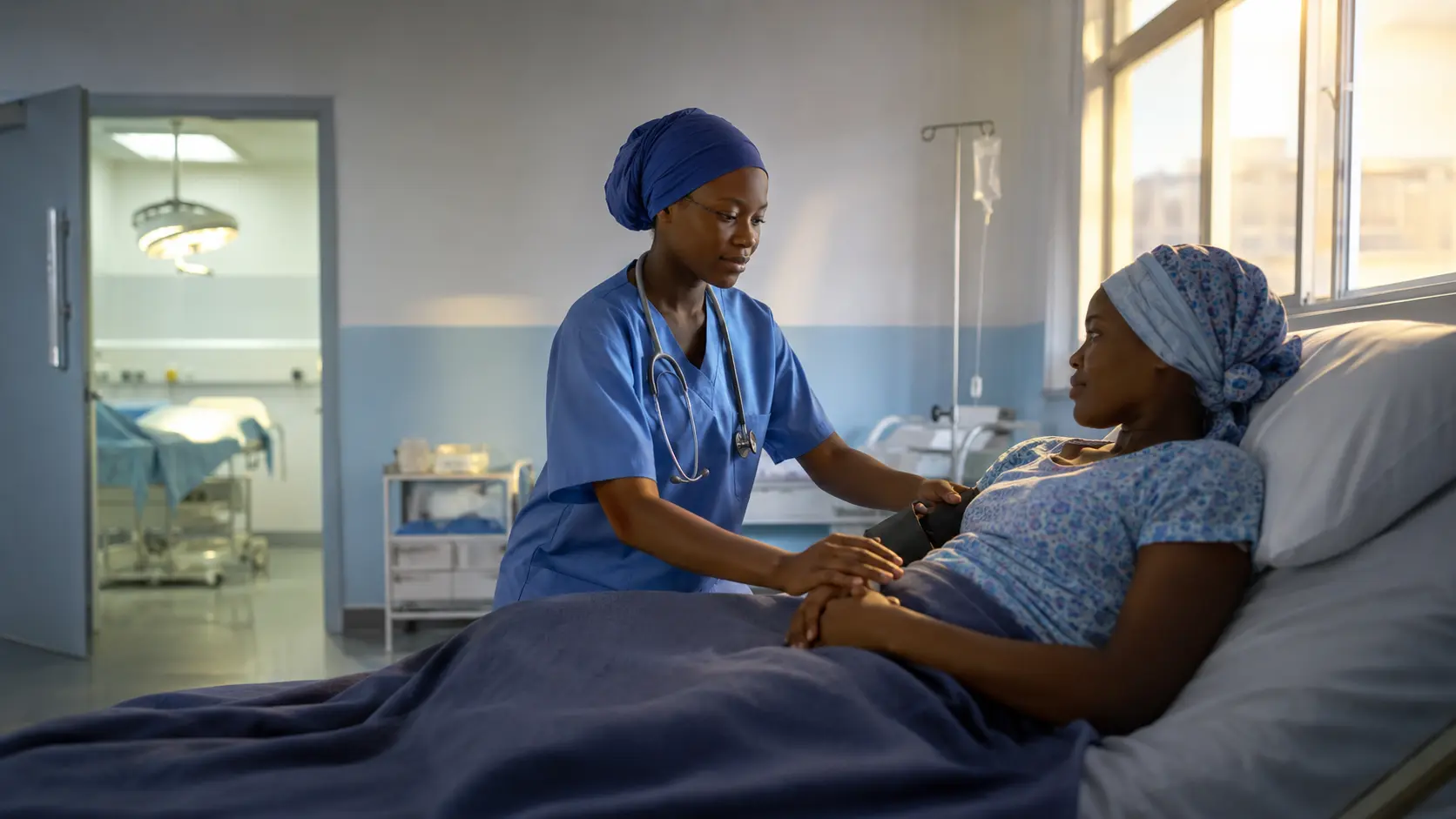
Pregnancy is not a disease. Yet for hundreds of thousands of women, becoming pregnant still introduces a risk of death that varies enormously according to the country, community and health system surrounding them. The latest internationally comparable estimates make that inequality difficult to ignore.
More than 700 maternal deaths every day
Approximately 260,000 women worldwide died from causes related to pregnancy and childbirth in 2023—more than 700 each day, or roughly one every two minutes.
Those deaths were not distributed evenly. Sub-Saharan Africa accounted for approximately 70 per cent of them: around 182,000 maternal deaths in a single year.
That number should stop us. It means the global story of maternal mortality is, to an extraordinary degree, an African story.
Africa has improved. That makes the remaining gap more frustrating.
It would be inaccurate to say nothing has changed. WHO reports that the maternal mortality ratio in its African Region fell by about 40 per cent between 2000 and 2023, from an estimated 727 maternal deaths per 100,000 live births to 442.
That decline represents women alive today who might not have survived pregnancy or childbirth a generation earlier: more births attended by trained professionals, stronger antenatal care, improved medicines and better management of complications.
The progress is real. It is simply not fast enough. The Sustainable Development Goal is fewer than 70 maternal deaths per 100,000 live births by 2030. WHO estimates that its African Region would need to accelerate its current rate of improvement roughly twelve-fold to meet that target.
Women are often not dying from mysterious causes
The central tragedy is not that medicine has no idea what is happening. Many maternal deaths are linked to complications health systems already know how to recognise and treat: severe bleeding, hypertensive disorders such as pre-eclampsia and eclampsia, infections, complications of labour, unsafe abortion and existing medical conditions aggravated by pregnancy.
The difference between survival and death can be startlingly ordinary. Is blood available? Can blood pressure be checked? Is the correct medicine in stock? Is someone trained to recognise deterioration? Can the patient reach a facility capable of emergency surgery? Is the operating theatre functioning? Is there electricity?
Maternal mortality is therefore one of the clearest measures of whether a health system works when a patient suddenly needs it most.
The dangerous hours are not always predictable
A woman can attend antenatal appointments and still develop an emergency during delivery. A pregnancy described as normal can become complicated rapidly. Maternal healthcare cannot depend only on identifying high-risk pregnancies in advance.
The system has to be prepared for the patient whose risk becomes obvious only after an emergency has begun. That requires more than a clinic building. It requires a chain: community awareness, transport, triage, skilled personnel, diagnostics, medicine, blood, referral, surgery when necessary and postpartum monitoring.
Break one important link and an otherwise treatable complication can become fatal.
Distance changes the meaning of an emergency
Imagine severe bleeding after childbirth in a major city hospital. Now imagine the same bleeding in a community where the first facility is an hour away—and that facility has no blood bank.
The patient must be referred again. Maybe transport is available. Maybe it is not. Maybe the second hospital has the staff. Maybe the theatre is already occupied. Medicine may know exactly what to do. The patient can still die before the health system manages to do it.
This is why discussions of maternal mortality cannot be reduced to individual behaviour. Telling women to go to hospital assumes the hospital is reachable, affordable, staffed and equipped. Those assumptions are not universally true.
Money can turn delay into danger
For some families, seeking care begins with a calculation: transport, admission, medicines, missed work and the possibility of surgery. When families fear the cost of care, they may wait. In obstetric emergencies, waiting is particularly dangerous.
A health system can technically possess a service while financial barriers make it functionally inaccessible to part of the population. Universal health coverage is not an abstract policy debate in maternal health. It determines whether a woman seeks help when the first warning sign appears or when the situation has become catastrophic.
Maternal survival is team medicine
Africa's maternal-health crisis cannot be separated from its wider health-worker shortage. A maternity ward does not benefit from a national staffing statistic. It benefits from the midwife who is actually on duty, the anaesthetist who can come now, the laboratory scientist who can process the sample, the surgeon who can operate and the blood-bank team that can prepare compatible blood.
Shortage at any critical point can change the outcome. The same maternity system also determines whether a newborn survives. WHO's African Region experiences roughly one million newborn deaths each year alongside its enormous maternal mortality burden.
The numbers reveal an inequality in who benefits from medicine
Women do not have fundamentally different bodies because they cross a border. Their health systems are different. Their access, incomes, transport, exposure to conflict and availability of blood, medicines and trained personnel are different.
Although global maternal mortality has fallen substantially since 2000, progress has slowed and the burden remains concentrated in low- and lower-middle-income countries. The world is increasingly confronting not a lack of medical knowledge but an inequality in who benefits from it.
What would actually move the numbers?
Not one intervention. The countries that progress fastest will likely improve several pieces at once.
- Skilled maternity care that more women can reach and afford.
- Reliable emergency obstetric and newborn services, including blood and surgery.
- Better detection and treatment of hypertension during pregnancy.
- Stronger referral, transport and ambulance systems.
- More midwives and other trained professionals where shortages are greatest.
- Financial protection so cost does not postpone care.
- Family-planning services and reliable maternal-death surveillance and review.
Africa does not need to accept this as normal
Very large numbers can become impossible to picture. But maternal mortality is not experienced as a statistic. It is a chair suddenly empty in a home, a newborn who will know a mother only through photographs, children whose lives change after one hospital admission and a family asking whether arriving twenty minutes earlier would have changed anything.
The most important fact in the maternal-mortality report may be the simplest: most maternal deaths are preventable. Africa has already made progress. Countries know many of the interventions that work. The region's extraordinary share of global maternal deaths is not inevitable. It is a measure of unfinished work.
The question for 2030 is not whether medicine knows how to save more mothers. It does. The question is whether African health systems can make that care available quickly enough, close enough and affordably enough that women survive to go home.
Sources & further reading
CHA Health uses named, traceable sources. Links open the original institutional material.
- UNFPA, WHO, UNICEF, World Bank Group and UN DESATrends in maternal mortality 2000 to 2023
- World Health OrganizationMaternal mortality: key facts
- WHO Regional Office for AfricaAfrican region's maternal and newborn mortality declining, but progress still slow
- World Health OrganizationTracking progress on maternal, newborn and child survival

Read thoughtfully.
Respond constructively.
Loading discussion…