
There is a particular kind of poverty that does not begin in the pocket. It begins in what you do not know.
The opportunity outside her field of vision
Imagine a woman who has spent years paying cash whenever someone in her family falls ill. Malaria means opening the drawer where emergency money is kept. A sick child means calling a relative. A laboratory request means deciding which bill can wait.
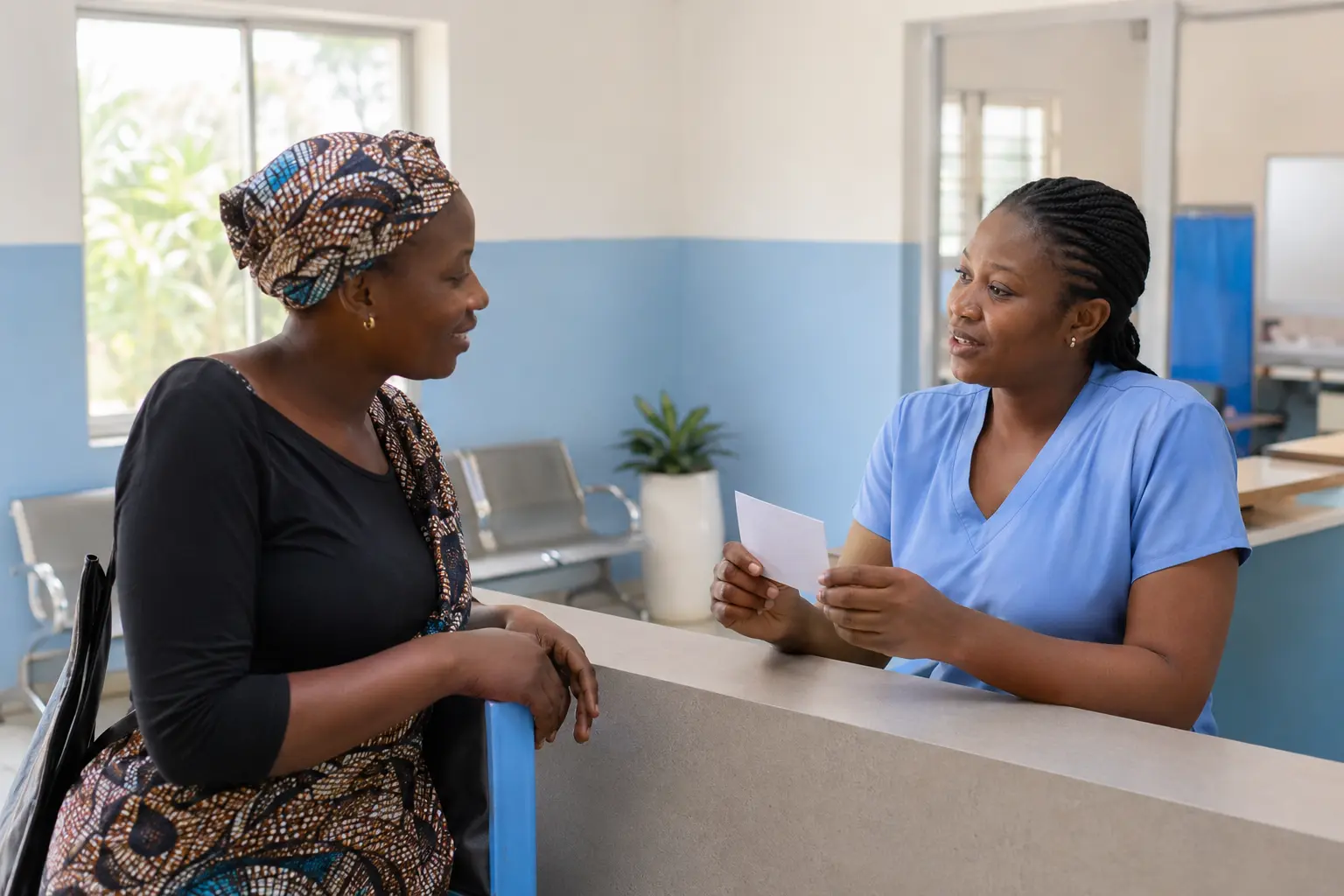
Nobody has explained the Basic Health Care Provision Fund to her. Nobody has told her that her state has a social health insurance agency. Nobody has sat beside her at a clinic and said: before you borrow money, let us first check what you may already qualify for.
So when she finally hears someone mention subsidised care, her first response is disbelief: ‘I thought healthcare like that was for rich people. ’ The scene is imagined. The information gap is not.
A 2025 study examining state-supported health insurance across six Nigerian states found that lack of awareness was the most significant factor associated with non-enrolment in every state studied. When healthcare exists but the people who need it do not know it exists, access has only been solved on paper.
The habit of paying first and asking later
Healthcare in Nigeria remains deeply associated with direct household payment. In August 2026, the World Health Organization reported that out-of-pocket spending accounted for about 72 per cent of Nigeria’s current health expenditure in 2023.
Behind that percentage are ordinary decisions. Should we go to the hospital tonight or see if the fever comes down? Can we afford the scan? Can we borrow? Can we manage until salary enters? Sometimes the greatest barrier is the actual price. Other times, it is the assumed price.
A person who believes treatment is automatically unaffordable may never reach the point where somebody can explain that assistance exists. That is why awareness is not a public-relations extra. It can affect whether a person seeks care at all.
There are programmes—but no single door
The Basic Health Care Provision Fund supports a Basic Minimum Package of Health Services and is intended particularly to improve access for poor and vulnerable Nigerians. According to the National Health Insurance Authority, its structure supports primary healthcare, health insurance for eligible vulnerable populations and emergency medical treatment.
That does not mean every Nigerian can walk into every hospital and receive every service without charge. It means that, before assuming there are no options, people should ask which pathway may apply to them.
Nigeria’s health system contains federal programmes, state health insurance schemes, employer coverage, NHIA programmes, maternal-health interventions and disease-specific support. The difficulty is that the average person is expected to discover how these parts fit together while they are already worried or unwell.
Information is infrastructure too
We speak about hospitals, doctors, medicines, ambulances and equipment as healthcare infrastructure. Information belongs on that list. A well-funded programme cannot help someone who has never heard its name. A subsidy cannot reduce a bill for a family that does not know where to apply.
Government agencies should communicate in language people understand. Facilities should be equipped to explain financial-support pathways. Community organisations and the media should treat access information as public-interest reporting, not as an obscure government announcement.
The final mile is not only getting resources to institutions. It is getting useful, current and understandable information to the person those resources were intended to reach.
What to ask before borrowing
You do not need to understand the entire health-financing system. Start with precise questions and keep a written record of the answers. Ask before assuming care is impossible, and ask early enough for the answer to change your options.
- At your primary health centre, ask whether the facility participates in the BHCPF and which services are covered.
- If you are uninsured, ask your State Social Health Insurance Agency about individual, family and vulnerable-person programmes.
- For a serious diagnosis, ask whether a disease-specific public, hospital or charitable intervention exists.
- Ask for eligibility criteria, covered services, referral rules and the official contact point in writing where possible.
- Never delay emergency treatment while trying to confirm financial support.
The inequality we measure too little
There are two versions of healthcare inequality. The first is when one person can afford care and another cannot. The second is quieter: two people may qualify for the same help, but only one knows it exists. One gets treated. The other goes home.
That second inequality cannot be solved only by constructing buildings. Access begins when the person a programme was created for knows where to find it, what it covers and whom to ask.
The NHIA advises people interested in BHCPF eligibility to contact the State Social Health Insurance Authority in their state of residence. Before paying alone, selling property or deciding there is no route forward, ask one more question: ‘Is there any programme I qualify for? ’
Sources & further reading
CHA Health uses named, traceable sources. Links open the original institutional material.
- BMC Public Health / PubMedExploring the determinants of enrollment in state-supported health insurance schemes in Nigeria
- WHO Regional Office for AfricaNigeria strengthens health financing capacity for universal coverage
- National Health Insurance AuthorityBasic Health Care Provision Fund
- National Health Insurance AuthorityState Social Health Insurance Agencies


Read thoughtfully.
Respond constructively.
Loading discussion…