
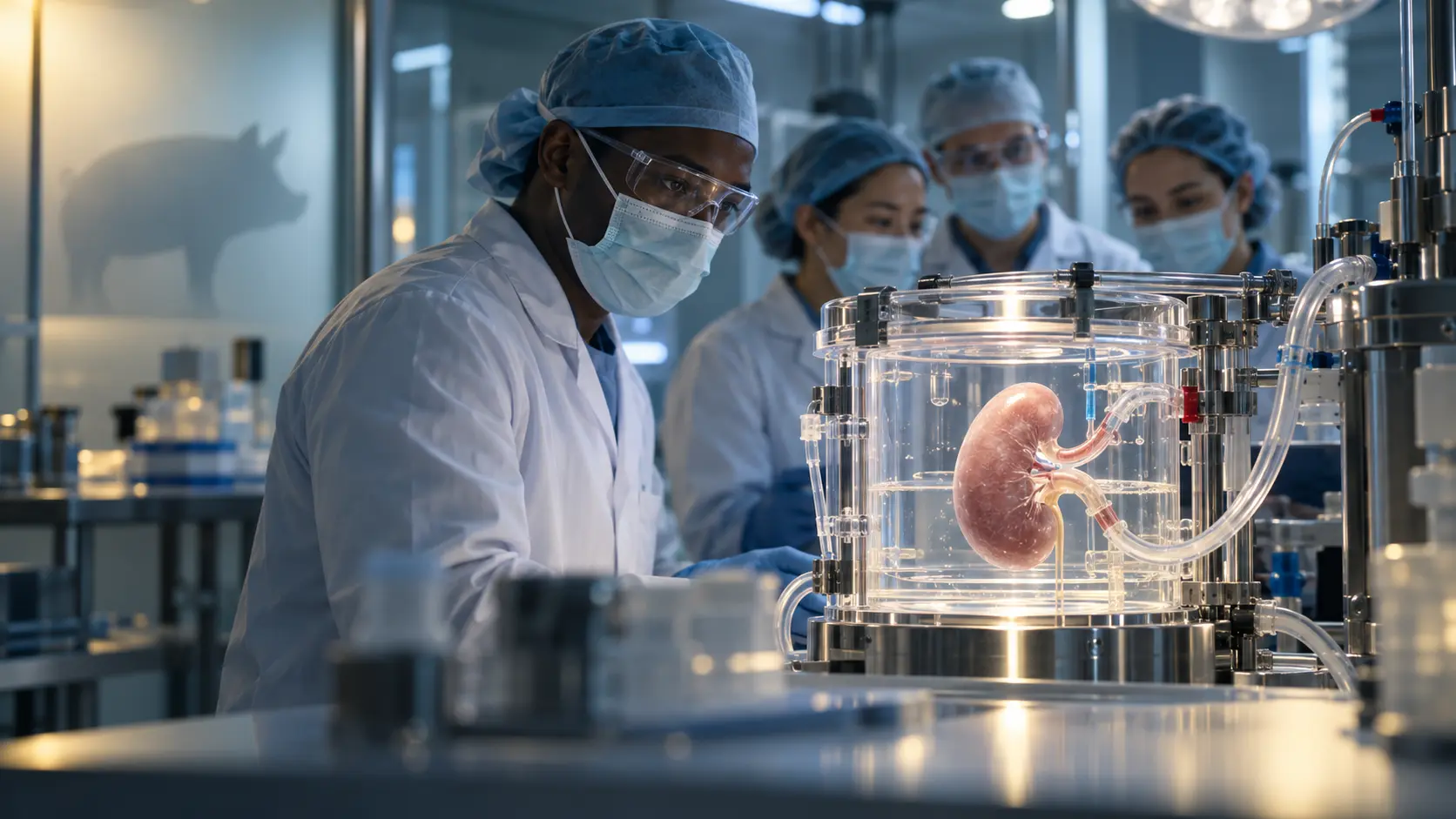
For 271 days, a kidney from a genetically engineered pig performed enough of the work of a 67-year-old man's failed kidneys to keep him off dialysis. It later failed and was removed. Eighty-two days after that, he received a human donor kidney. The sequence—pig kidney, dialysis-free life, graft removal, then successful human transplantation—had never before been described in a living patient.
The number is extraordinary. The whole story matters more.
The case was published online in The Lancet on 3 September 2026 as the first report of porcine kidney xenotransplantation used as a bridge to human kidney transplantation. The patient had end-stage kidney disease, no suitable living donor and a long anticipated wait for a deceased donor organ.
On 25 January 2025, surgeons at Massachusetts General Hospital transplanted a gene-edited pig kidney known as EGEN-2784. It began functioning immediately and supported the patient without dialysis for 271 days—the longest dialysis-free survival then reported after a pig-kidney transplant in a living person.
The graft was not permanent. It developed progressive injury and was removed. The patient returned to dialysis for 82 days before receiving a deceased-donor human kidney, which functioned immediately. At 231 days of follow-up after the human transplant, the study reported no evidence that exposure to the pig kidney had sensitised him in a way that damaged the human graft.
Why use a pig organ at all?
A kidney transplant can offer people with end-stage kidney disease better survival and quality of life than remaining on dialysis. The central problem is supply. Human kidneys from deceased and living donors are limited, and people can wait years while their health deteriorates.
Pigs are being studied as potential organ donors because their organs are broadly compatible in size and physiology, they can be bred in controlled conditions and modern gene editing can remove or alter biological signals that trigger immediate rejection in humans.
The idea is called xenotransplantation: moving living cells, tissues or organs between species. It is not new. What has changed is the capacity to edit the donor animal, monitor infection and shape the recipient's immune response with far greater precision than earlier generations of medicine could manage.
Sixty-nine edits stood between the pig and the patient
The donor pig's genome had been modified extensively. The study describes deletion of major pig glycan antigens that the human immune system readily recognises as foreign, insertion of seven human genes intended to improve compatibility, and inactivation of porcine endogenous retroviruses embedded in the pig genome.
Counting edits can make the organ sound engineered into safety. Biology is not that simple. The recipient still required powerful, carefully designed immunosuppression. The clinical team monitored kidney function, antibodies and microbes, including with metagenomic sequencing.
The engineering addressed known barriers. It did not remove every path by which the graft could be injured.
The kidney was rejected early—and rescued
A biopsy on day 14 showed T-cell-mediated rejection. The team treated it, and the rejection resolved. Kidney function then remained broadly stable for about six months.
Later, the patient's immunosuppression was reduced while clinicians managed a bacterial infection that did not come from the pig. Injury emerged in the graft's small blood vessels and progressed to thrombotic microangiopathy, a form of damage involving tiny vessels and clotting. The organ ultimately failed despite tests remaining negative for the conventional donor-specific antibodies clinicians often associate with antibody-mediated rejection.
This was not a footnote to the breakthrough. It was one of its most valuable findings. The pattern suggests that late pig-kidney injury may involve immune mechanisms that current monitoring and treatment do not yet fully control.
The infection question did not disappear
Moving an organ from an animal into a human creates a risk that an animal pathogen could cross species. That is not only a question for the recipient; in the worst case, it could become a public-health concern.
The study found no transmission of pig pathogens during the reported follow-up. That is reassuring, but one negative result in one intensively monitored person cannot establish long-term population safety. The United States Food and Drug Administration has long treated source-animal health, screening, lifelong surveillance and archiving of samples as central parts of xenotransplant regulation.
Any future programme will therefore require much more than transplant surgeons. It will require veterinary biosecurity, genomics, infectious-disease expertise, laboratories, data systems, long-term patient follow-up and transparent public-health oversight.
A bridge may be the first realistic use
The case changes one strategic question. A pig kidney does not necessarily have to last for the rest of a person's life to be useful. If it can safely keep a patient off dialysis while a human organ becomes available, it may serve as a bridge.
That could protect health and quality of life during a long wait. It could also create time. But temporary benefit must be weighed against major surgery, intensive immunosuppression, infection risk, the possibility of graft failure and another transplant operation later.
The word bridge should not make the journey sound simple. This patient received highly specialised care at a leading transplant centre under a United States FDA expanded-access investigational application. The paper describes the first participant in a planned three-patient study, not an ordinary service ready for hospitals to offer.
What this could mean for Africa—and what it does not
Organ scarcity is not confined to wealthy countries. Across Africa, kidney failure often collides with limited dialysis availability, the cost of repeated treatment, small transplant programmes and weak deceased-donor systems. A future source of additional organs would matter enormously.
But a technically successful organ does not automatically create equitable access. Xenotransplantation demands capabilities many health systems do not yet provide consistently: complex surgery, potent medicines, pathology, molecular surveillance, infection control and lifelong monitoring.
If the technology matures while remaining exceptionally expensive and concentrated, it could widen the distance between what medicine can do somewhere and what patients can receive where they live. African research institutions, regulators, ethicists and patient communities should be part of the conversation early—not only when a finished technology is ready to be sold.
There is an animal-ethics question too
Creating pigs specifically as organ sources raises questions about animal welfare, breeding conditions, genetic modification and what obligations humans have to animals used in medicine. Different communities will answer those questions differently.
There are also human questions: who should enter early trials, how uncertainty is explained, what lifelong monitoring participants must accept, how privacy is protected and who pays for complications that appear years later.
Calling the work lifesaving does not eliminate those questions. It makes careful answers more urgent.
So, is this the future of kidney transplantation?
Possibly. It is not yet the present.
The study establishes that a gene-edited pig kidney can provide prolonged dialysis-free support in a living patient and that subsequent human transplantation can succeed without detectable sensitisation in that case. It also documents early rejection, infection-related changes to treatment, severe late vascular injury and eventual graft failure.
That combination—promise and failure in the same patient—is exactly why the report matters. Breakthroughs are not always clean victories. Sometimes they are the first time medicine learns enough from an imperfect outcome to make the next attempt safer.
One patient cannot answer whether pig kidneys will be durable across different ages, illnesses and immune systems; whether uncommon infections will emerge; which genetic edits are essential; what immunosuppression will work best; or whether the procedure can be delivered at a cost health systems can sustain.
The 271 days are not proof that the organ shortage is solved. They are proof that an idea once treated as remote can support a human life for months—and that the scientific questions have moved from whether it can work at all to how reliably, safely and fairly it can work next.
Sources & further reading
CHA Health uses named, traceable sources. Links open the original institutional material.
- The Lancet / PubMedPorcine kidney xenotransplantation as a bridge to allotransplantation: a first-in-human study
- Harvard Medical SchoolPatient who received pig kidney becomes first to progress to human kidney transplant
- U.S. Food and Drug AdministrationSource Animal, Product, Preclinical, and Clinical Issues Concerning the Use of Xenotransplantation Products in Humans
- The GuardianA record nine months with a genetically modified pig kidney


Read thoughtfully.
Respond constructively.
Loading discussion…