
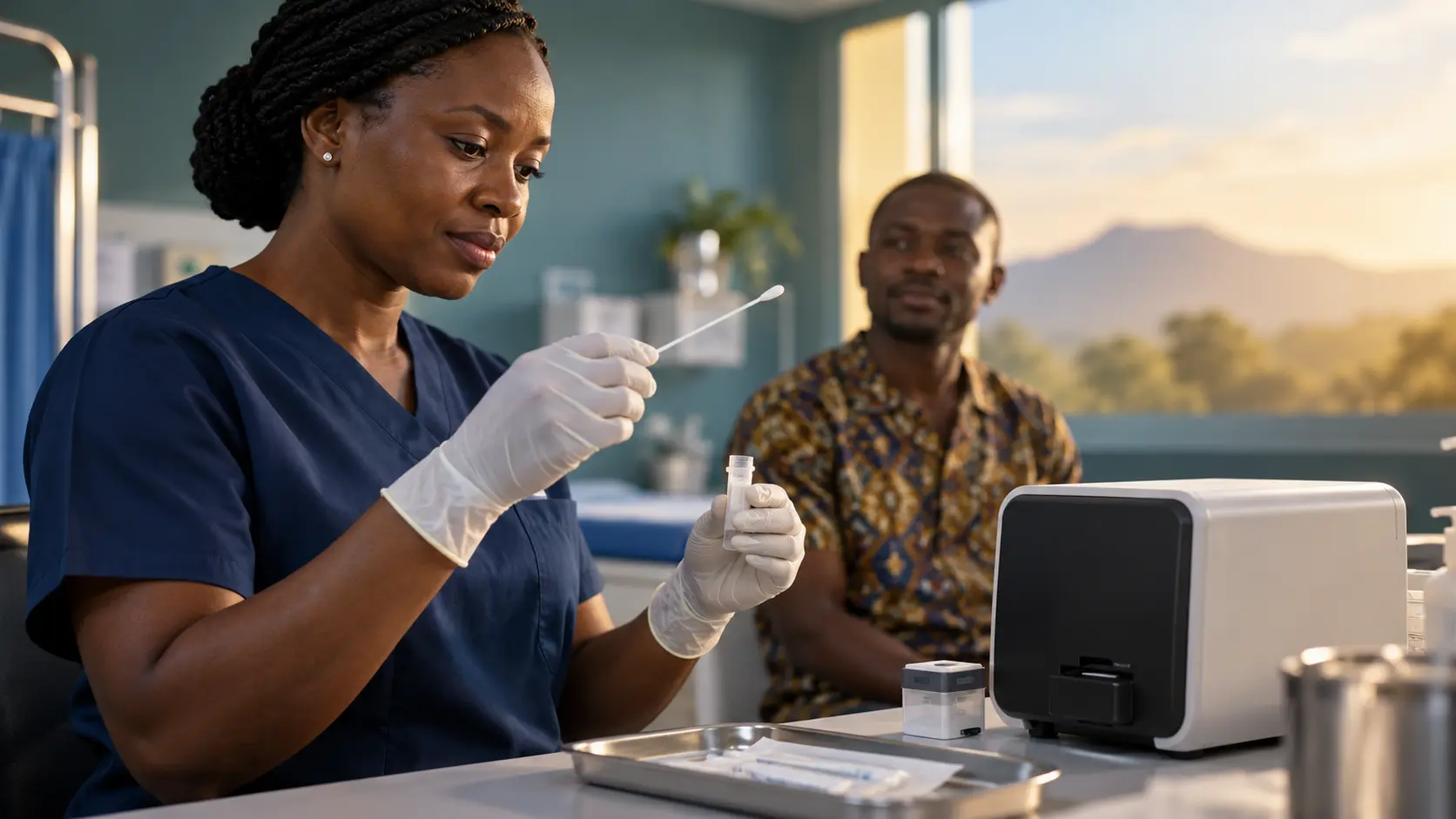
For more than a century, one of the central instructions in tuberculosis testing has sounded simple: cough up a sample. It is not simple for everyone. In March 2026, the World Health Organization made its first recommendations for a new class of molecular tests designed to work nearer to where people seek care—and for tongue swabs as an easier specimen in defined patients who cannot produce sputum.
The sample can become the barrier
Tuberculosis diagnosis has often depended on sputum: mucus brought up from deep inside the lungs. For many adults with pulmonary TB, it remains an important specimen. But some people cannot produce enough of it when asked. The problem is particularly familiar in children, people who are very unwell and patients whose disease does not produce a forceful cough.
A diagnostic pathway can therefore fail before a laboratory machine ever begins. The test may exist. The trained staff may exist. The patient may have reached the clinic. But if the required sample cannot be collected, certainty—and treatment—can be delayed.
This is why a swab rubbed across the tongue is more than a change in equipment. It changes what the patient must be able to do.
What WHO changed in 2026
On 9 March 2026, WHO announced its first recommendations for near-point-of-care nucleic acid amplification tests, or NPOC-NAATs, for the initial detection of TB. These are molecular tests intended for use at peripheral laboratories, primary healthcare centres and community settings, rather than only in larger central laboratories.
WHO also recommended tongue swabs for use with specified near-point-of-care and low-complexity automated molecular tests among adults and adolescents who cannot produce sputum. Depending on the test class, the approach can support initial detection of TB with or without rifampicin resistance.
A third recommendation concerned sputum pooling: combining samples for molecular testing in settings where resources are constrained, with the aim of reducing costs and improving turnaround time while retaining a route to identify individual positive samples.
These are three related attempts to narrow the same distance—the gap between suspecting TB and confirming it quickly enough to begin appropriate care.
Near the patient matters
A highly accurate test in a distant laboratory is not automatically an accessible test. Samples need transport. Results need to return. Machines need stable power, maintenance and trained operators. Patients may be asked to come back, and some will be unable to do so.
Near-point-of-care testing does not remove every one of those requirements. It can, however, shorten the chain. A compact molecular platform located closer to a patient can make same-visit or faster decisions more plausible and reduce the number of places where a person disappears between testing and treatment.
That possibility matters in Nigeria. WHO's Nigeria office reported in March 2026 that the country is estimated to have about 510,000 new TB cases each year, including around 61,000 among children. Nigeria notified 458,534 TB cases in 2025—an important improvement, but still evidence of a disease requiring far more than passive diagnosis in specialist hospitals.
The science did not begin with the recommendation
WHO recommendations follow evidence review; they are not announcements made because an idea sounds convenient. A multi-country evaluation published in EBioMedicine studied late prototypes of two swab-based molecular platforms in outpatient clinics in India, Uganda and Viet Nam.
The study enrolled people aged 12 years and older with presumptive TB and compared the new tests with a culture-based reference standard. Both platforms exceeded WHO's minimum accuracy targets for the specimen types evaluated. Tongue-swab testing was less sensitive than the same general approach using sputum swabs, while specificity remained high.
That detail is essential. Easier sampling creates value, but an easier test is not useful if its limitations are hidden. A negative tongue-swab result cannot be interpreted as a universal guarantee that a person does not have TB. Clinical symptoms, exposure, imaging, local diagnostic algorithms and further testing may still matter.
This is not a home test for everyone
The words tongue swab may invite comparison with rapid tests people use at home. That is not what WHO recommended. The swab is a specimen collected for a molecular testing system, and the recommendation applies to specific technologies and clinical situations.
Nor does the guidance mean every clinic in Nigeria—or every TB programme globally—already has the equipment. Countries must update policy, select products, secure financing, train staff, build quality assurance, manage supplies and decide where the tests fit within existing diagnostic networks.
WHO has specifically encouraged national TB programmes to seek technical advice before introducing the technologies. Recommendation is the beginning of implementation, not proof that implementation has already happened everywhere.
A breakthrough can still be defeated by ordinary logistics
The machine needs cartridges. The clinic needs electricity or dependable backup power. Staff need training. Results need to be recorded and acted upon. People diagnosed with TB need the correct medicines and the support required to complete treatment.
If a community does not know where testing is available, a smaller machine changes little. If a positive result is followed by a stock-out, diagnosis has not completed the public-health job. If new tools remain concentrated in well-resourced cities, the people facing the longest diagnostic journeys may see the least benefit.
Médecins Sans Frontières has therefore treated near-point-of-care testing as an operational challenge as well as a technical one. Its 2026 implementation report emphasises procurement, maintenance, quality systems, staffing and the decisions national programmes must make if the new class of tests is to be sustainable.
Why finding TB earlier changes more than one life
TB is treatable, but treatment cannot begin for a disease nobody has identified. Delay gives illness time to progress and creates more opportunity for transmission to other people in homes, workplaces, schools and public transport.
WHO estimated that 10. 7 million people developed TB globally in 2024. Of those, 8. 3 million were newly diagnosed and officially notified, leaving an estimated gap of about 2. 4 million people between incidence and notification. That gap includes people who were missed, diagnosed late, not reported, or never reached by the health system.
No single device will close it. But a test that can travel farther down the health system, accept an easier sample from some patients and return a molecular result closer to the point of care attacks several practical causes of delay at once.
The real breakthrough is a shorter journey to an answer
It is tempting to celebrate medical progress at the level of the machine: smaller, faster, cheaper, more sophisticated. Patients experience progress differently.
For them, progress may mean one fewer trip. One less day of waiting. A child who does not have to produce sputum on command. A primary-care worker able to move from suspicion to action without sending a sample across a state. A person beginning treatment before becoming dangerously ill.
The 2026 recommendation does not end tuberculosis. It does something more precise: it gives health systems new ways to make diagnosis fit the patient, instead of requiring every patient to fit an old diagnostic pathway.
Now comes the part that determines whether a recommendation becomes a breakthrough in real life—getting the right test, to the right clinic, with the supplies, training and treatment pathway required to make the result matter.
Sources & further reading
CHA Health uses named, traceable sources. Links open the original institutional material.
- World Health OrganizationWHO recommends near-point-of-care tests, tongue swabs and sputum pooling for TB diagnosis
- World Health OrganizationNear point-of-care tests, tongue swabs and sputum pooling for TB
- EBioMedicine / PubMedDiagnostic accuracy of swab-based molecular tests for tuberculosis using near-point-of-care platforms
- The New England Journal of MedicinePulmonary Tuberculosis Detection with MiniDock MTB Using Tongue Swabs
- Médecins Sans FrontièresNear point-of-care tests for tuberculosis: implementation report
- WHO Regional Office for AfricaNigeria intensifies tuberculosis response to close detection gaps
- World Health OrganizationGlobal Tuberculosis Report 2025
Read thoughtfully.
Respond constructively.
Loading discussion…