
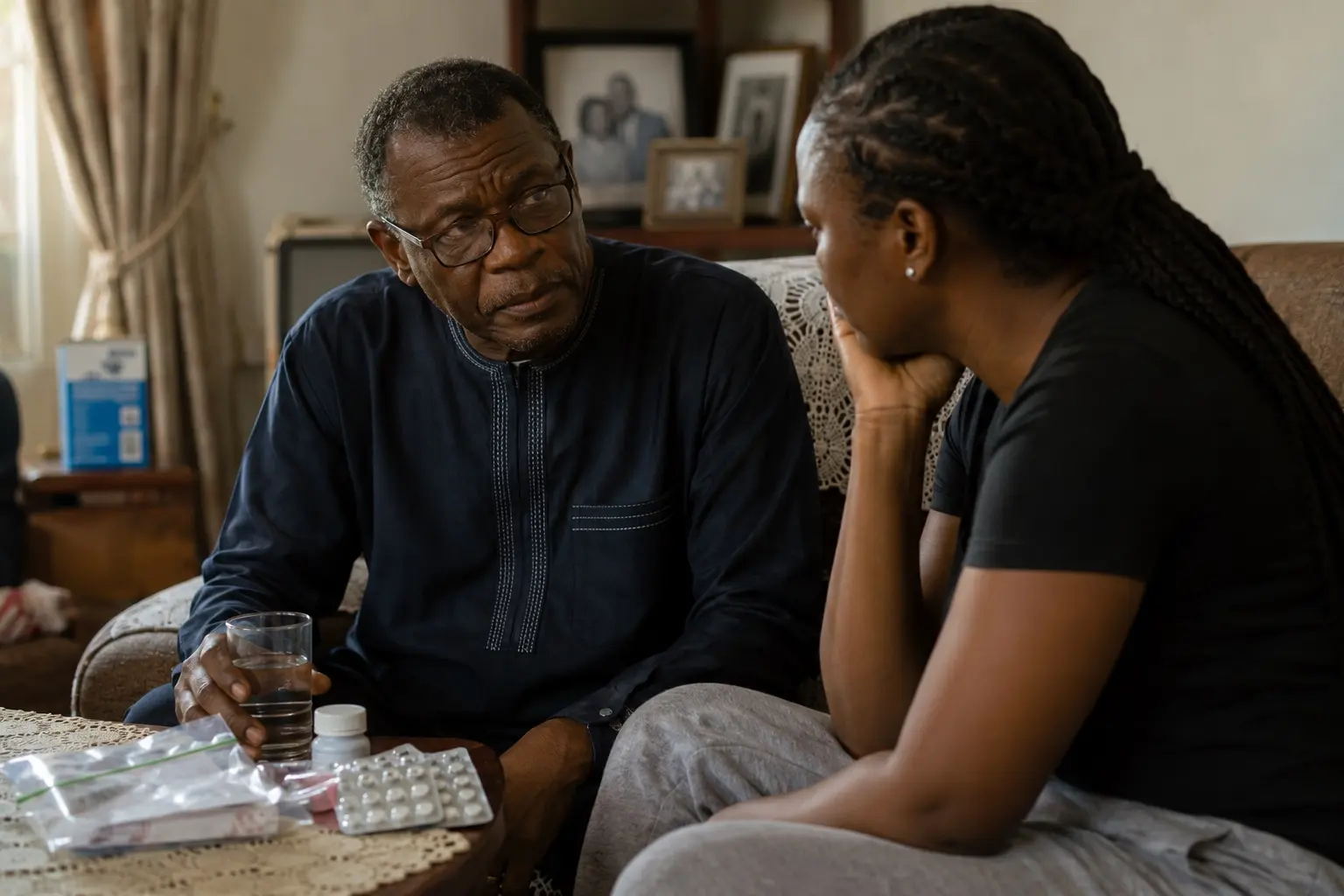
You find out accidentally. There is medication in a bag you were not looking for, a hospital card falls out of a drawer, or an aunt mentions an appointment she assumes you already know about. The first feeling may not even be fear. It may be anger.
Parents get very good at editing information
Why didn’t you tell me? It seems such an obvious question that we rarely consider what the answer might sound like from the other side: what exactly would telling you have done except make you afraid too? That answer can be infuriating. It can also contain more love than it first appears to.
Children generally discover quite late that their parents have been filtering reality for them all their lives. There were probably money problems you never knew about, arguments you slept through, school fees that were difficult but somehow paid, and bad news softened before it reached you.
Being a parent often involves deciding which worries belong to the whole family and which ones you can carry yourself. The habit does not necessarily disappear because the children become adults. A 68-year-old woman may have a 39-year-old daughter with a career, children and problems of her own. Everybody else sees a grown woman. Her mother may still see the child she spent decades trying not to frighten.
So chest pain becomes a little discomfort. A biopsy becomes some tests. The hospital visit becomes ‘I went to see the doctor’. If the result is not yet certain, there is another reason to wait: why ruin everybody’s week over something that may turn out to be nothing? That logic can continue for longer than anybody intended.
There is a difference between privacy and secrecy
Research with chronically ill older Nigerians found that participants placed enormous importance on privacy, self-sufficiency and appearing well. They were selective about who knew they were ill, particularly outside their closest family circles. Researchers linked concealment to maintaining normality and avoiding being treated differently or looked down upon.
That desire is easy to underestimate. Once people know you are sick, conversations can change. You enter a room and somebody immediately asks about your health. People watch what you eat, tell you to sit down, ask whether you should be travelling and exchange concerned looks when you cough.
Everybody may mean well. It can still be irritating. For someone who has spent forty years being capable and independent, illness introduces an identity they did not ask for: patient. Keeping something private can be a way of keeping ordinary life ordinary for a little longer.
‘I didn’t want to bother you’
There are sentences parents use so often that families stop hearing what is underneath them: I didn’t want to disturb you. You have your own problems. I knew you were busy. There was no point telling you yet.
Concern about becoming a burden is not imaginary. Older adults in care research have described limiting family involvement because they did not want to complicate their adult children’s busy lives or cause excessive worry.
In Nigeria, family is often the support system. Research in peri-urban Ibadan involving 460 adults with older parents found that 32. 4 per cent said their parents relied on children as a source of income. Financial support was also identified as the largest unmet social-support need.
That changes what it means to announce an illness. ‘I have been diagnosed’ may also mean: I may need money, transport, help collecting medicine, somewhere to stay, or for you to leave work and rearrange things because of me. A parent does not need to dislike their children to find that difficult. Quite the opposite.
Then there is money
There is an easy version of health advice in which a person notices a worrying symptom, books an appointment, undergoes the recommended tests and begins treatment. Real life has invoices.
A nationally representative study of more than 3,500 Nigerians aged 50 and above found that lower household income and lack of education were associated with lower rates of consulting healthcare professionals when people were ill. Financial and social barriers were important obstacles to care.
Sometimes a parent has not told the family because telling the family turns a private symptom into a financial problem. There may be a consultation fee, tests, another test because the first was inconclusive, medicine, transport, treatment in another city and someone who must accompany them.
A person may wait until they know whether the problem is ‘serious enough’ to justify involving everyone. Unfortunately, illnesses do not negotiate according to family budgets. Delay can turn a manageable problem into precisely the large family emergency the person was trying to avoid.
The difficult reversal
For most of the relationship, the parent has been the parent. Then a daughter starts asking whether medicine has been taken. A son asks to speak directly to the doctor. Someone takes the car keys because Dad’s eyesight is no longer good enough. Appointments enter the family calendar, food is monitored and money is transferred.
Necessary? Sometimes. Easy to accept? Not necessarily. Nigerian research on intergenerational support shows how deeply reciprocity runs through these relationships. Older parents described the support they had given their children as substantial and sacrificial; adult children often saw later care as repayment.
There is tenderness in that arrangement. There can also be discomfort. A father who paid everybody’s school fees may not enjoy asking his daughter to pay for a scan. A mother who spent thirty years telling everyone else what to do may not appreciate being told she can no longer go somewhere alone.
Children may see protection. Parents may occasionally experience it as the beginning of losing control over their own lives. That makes disclosure more complicated than simply telling your family whenever something is wrong.
Sometimes they are protecting themselves, not you
Not every secret is an act of parental sacrifice. Sometimes people are frightened. Telling another person makes a possibility real. A strange lump can remain a strange lump while nobody knows about it. Once you tell your children, there will be questions: Have you seen a doctor? When? What did they say? When is the test? Have you collected the result?
Silence can buy time. Not necessarily useful time, but time before a frightening possibility acquires appointments, names and dates. There may also be fear of what an illness represents: cancer, dementia, kidney disease, a stroke, loss of sight, dependence, disability or death.
Families keep secrets in both directions. An adult child loses a job and waits before telling Mum. There is trouble in a marriage, but Dad is getting older and there is ‘no need to worry him’. A medical test comes back abnormal: I’ll tell them when I know more.
Families sometimes behave as if worry is a substance that can be contained by giving it to as few people as possible. Everyone is protecting everyone. Nobody has quite agreed to this arrangement.
Because there is a cost to not knowing
There are things families would have done differently if they had known earlier: made the appointment, found the money, asked another doctor, come home, paid more attention, spent more time together, or simply been present while the person was afraid.
When somebody decides ‘I don’t want them to worry’, they make another decision without necessarily intending to: I will do the worrying alone. Privacy can preserve dignity. It can also become isolation.
Research on chronic illness among older Nigerians consistently places family near the centre of care. Family members provide money, transport, physical assistance and emotional support. Caregivers have also described disruption to family life, effects on their own health and social isolation alongside their commitment to the person they love.
Illness may begin in one body. Its practical consequences rarely remain there.
Perhaps ‘Why didn’t you tell me? ’ is the wrong first question
If you discover that someone you love has been unwell for weeks or months, anger and fear are understandable. But there might be a better first conversation. Not: How could you hide this from us? Maybe: What made you feel you couldn’t tell us?
The answers could be useful. I didn’t want you spending money on me. I thought it would go away. I was frightened. I didn’t want everybody treating me like an invalid. I knew you were having problems at work. I wanted to understand what was happening first. I didn’t want you flying home because of me.
Perhaps telling us would have done nothing except make us afraid. We might have worried at night, called too often and even been annoying. But we could have been afraid together.
There are illnesses a family cannot cure and diagnoses love cannot change. That does not make telling someone useless. Sometimes the purpose is not to hand them a problem to solve. It is simply to stop carrying it alone.
Sources & further reading
CHA Health uses named, traceable sources. Links open the original institutional material.
- PubMed CentralThe Need to Appear Healthy: Concealment of Chronic Illness, Privacy, and Self-Sufficiency Among Chronically Ill Older Nigerians
- PubMedFactors associated with the healthcare-seeking behaviour of older people in Nigeria
- PubMed CentralAdults and Social Supports for Older Parents in Peri-Urban Ibadan, Nigeria
- PubMed CentralYou Don’t Want to Burden Them: Older Adults’ Views on Family Involvement in Care
- PubMedCaring for the seniors with chronic illness: The lived experience of caregivers of older adults
- PubMedIntergenerational Support between Older Adults and Adult Children in Nigeria: The Role of Reciprocity
- PubMedInforming or concealing: Dynamics of telling disease-related bad news among family members of older cancer patients
Read thoughtfully.
Respond constructively.
Loading discussion…